Article


Asset concealment has become a growing challenge as ownership grows increasingly international and assets more mobile. Globalisation and digitalisation have expanded legitimate cross-border finance, but also created more opportunities to conceal ownership, control and economic benefit. It is now routine for individuals and businesses to hold companies, bank accounts, real estate, securities, intellectual property and digital assets across multiple jurisdictions. Most cross-border structures serve legitimate commercial, tax, treasury, privacy or succession purposes. However, the same infrastructure can be misused to obscure who ultimately owns, controls or derives economic benefit from an asset, making beneficial ownership more difficult to identify. Shell companies, opaque ownership structures and trade-based laundering networks can provide a bridge between illicit wealth and the legitimate global economy, enabling financial crime, sanctions evasion, organised crime and hostile state activity.
As ownership becomes more international, assets more mobile and technology more accessible, separating legal title from effective control and economic benefit becomes easier to engineer and harder to detect, increasing the risk to financial integrity and global security.
Asset concealment is the deliberate act of hiding or disguising ownership or control of assets. The aim is often to evade legal scrutiny and prevent authorities, creditors and other claimants from tracing and seizing assets. The consequences extend far beyond individual disputes or asset recovery proceedings. Concealed ownership and control can frustrate court judgments and confiscation orders, weaken sanctions regimes, disguise the proceeds of corruption and organised crime, and enable hostile states and their proxies to retain access to assets, markets and financial services. It can also prevent financial institutions and counterparties from identifying the people and relationships behind a transaction, limiting their ability to assess and manage risk.
Most concealment strategies pursue two primary objectives: (1) to disrupt the evidentiary chain of ownership, and (2) to facilitate the rapid transfer of assets beyond the reach of enforcement. Common methods include offshore companies, trusts, nominees, shell entities and complex financial structures. Funds may also move through multiple jurisdictions and into different asset classes, including securities, real estate, high-value collectables and digital assets like cryptocurrencies.
With each additional entity, intermediary, jurisdiction or asset type, it becomes harder to conduct effective asset tracing, freeze assets or recover them. The cumulative effect, not any one step in isolation, increases the time, cost and legal coordination needed to reconstruct the full picture. Beyond the enforcement challenge it represents, asset concealment poses a broader threat to financial integrity and, in its most serious forms, national and international security.
Several developments have widened the gap between the territorial reach of authorities and the cross-border networks through which value can be held and moved. The following four developments have made concealment easier.
Ownership, control, income streams and asset location can be divided across entities and jurisdictions with different disclosure and enforcement regimes. Funds may then be routed through companies, trusts and nominees, or converted into other asset classes. Each step may appear legitimate when viewed in isolation. Taken together, however, the layers can conceal the arrangement’s economic purpose and create distance between an asset and the person who ultimately owns, controls or benefits from it.
Specialist professional advisers and service providers can give complex structures both technical sophistication and an appearance of legitimacy. Their expertise may be misused to distance those directing an arrangement from the entities and assets involved. Greater access to these services has made elaborate concealment easier to deploy and scale.
Digital assets allow value to move rapidly across borders, often without relying on traditional financial intermediaries. Although many cryptocurrency transactions are recorded on public blockchains and can be traced through transaction analytics, several techniques can disrupt the evidentiary trail. Mixers combine assets from multiple users, privacy-enhancing cryptocurrencies obscure transaction details, and chain hopping moves value between different blockchain networks. Decentralised exchanges, nested wallets and intermediary service providers can create further separation between counterparties, particularly where customer identification is limited. While transactions remain visible, these methods make attribution more difficult and increase the time, cost and technical complexity of identifying the parties involved and the ultimate destination of funds.
US and EU agencies, including the US Department of the Treasury’s Office of Foreign Assets Control (OFAC)[1]https://ofac.treasury.gov/media/913571/download?inline, the US Government Accountability Office (GAO)[2]https://www.gao.gov/assets/d24106178.pdf, and the European Commission[3]https://cointelegraph.com/news/eu-sanctions-block-russian-crypto-platforms-drone-strikes, have warned that digital assets can complicate sanctions enforcement, even as on‑chain analytics increasingly help investigators follow the money with some success.
The internationalisation of asset ownership has created a global infrastructure for moving and storing valuable assets, including freeports and private storage facilities. Freeports combine secure storage and tax deferral with varying degrees of ownership confidentiality. Where valuable assets such as artwork are held through complex legal structures and transferred privately while remaining within a freeport, tracing beneficial ownership and monitoring transactions is challenging without insider knowledge. Freeport arrangements are not intrinsically illicit, but international organisations and regulatory authorities, including the Financial Action Task Force (FATF), HM Revenue & Customs (HMRC), the European Parliament, and the OECD-related Free Trade Zone initiatives, have highlighted that freeports and free trade zones may present elevated financial crime risks where customs oversight, transparency and beneficial ownership disclosure are insufficient. [4]https://www.fatf-gafi.org/en/publications/Methodsandtrends/Money-Laundering-Terrorist-Financing-Art-Antiquities-Market.html; … Continue reading
The market for high-end artwork is particularly attractive for rapidly and covertly transferring wealth because it combines flexible valuation, opaque transaction structures, and the ability to move significant value through portable assets. When paired with quid pro quo arrangements, where parties exchange benefits or assets on a reciprocal basis, the art sector can serve as more than a marketplace for collectors. It can function as an alternative financial channel for transferring and concealing assets, avoiding tax and circumventing sanctions.
Over the past 20 years, a series of high-profile cases has shed light on how organised crime groups have used high-value artworks as collateral and hidden collections (such as the one found in the possession of the Sinaloa cartel’s kingpin Joaquin Guzmán “El Chapo”) to launder millions and conceal the proceeds of crime. [5]https://www.ft.com/content/2c00ddfa-0d82-4f87-9d0d-35291c0ee2f0; https://news.artnet.com/art-world/3-drug-kingpins-art-adored-316531
Concealment allows actors to preserve access to wealth, goods, markets and services while obscuring the relationships that would expose their conduct or trigger legal and commercial consequences.
The United Nations Office on Drugs and Crime (UNODC) estimates that 2 to 5% of global GDP (USD 800 billion to 2 trillion) is laundered each year as part of the ever-growing size of the global criminal economy.[6]https://www.unodc.org/unodc/en/money-laundering/overview.html Concealment structures can also obscure criminal conduct, human rights violations, environmental harm, community displacement, trafficking, forced labour, corruption and other forms of abuse.
The underlying harm often becomes visible only through investigations, enforcement action, litigation, media scrutiny or civil society reporting.
Since 2022, enforcement bodies have observed rapid re-routing of trade and finance through third countries not directly bound by a given regime, alongside asset restructuring and proxy ownership arrangements designed to obscure the links between sanctioned persons and their assets.[7]https://www.clingendael.org/sites/default/files/2025-11/Policy_brief_Thirdcountry_involvement_sanctions_evasion.pdf The strategic objective is not concealment itself, but continued access to goods, capital and international markets.
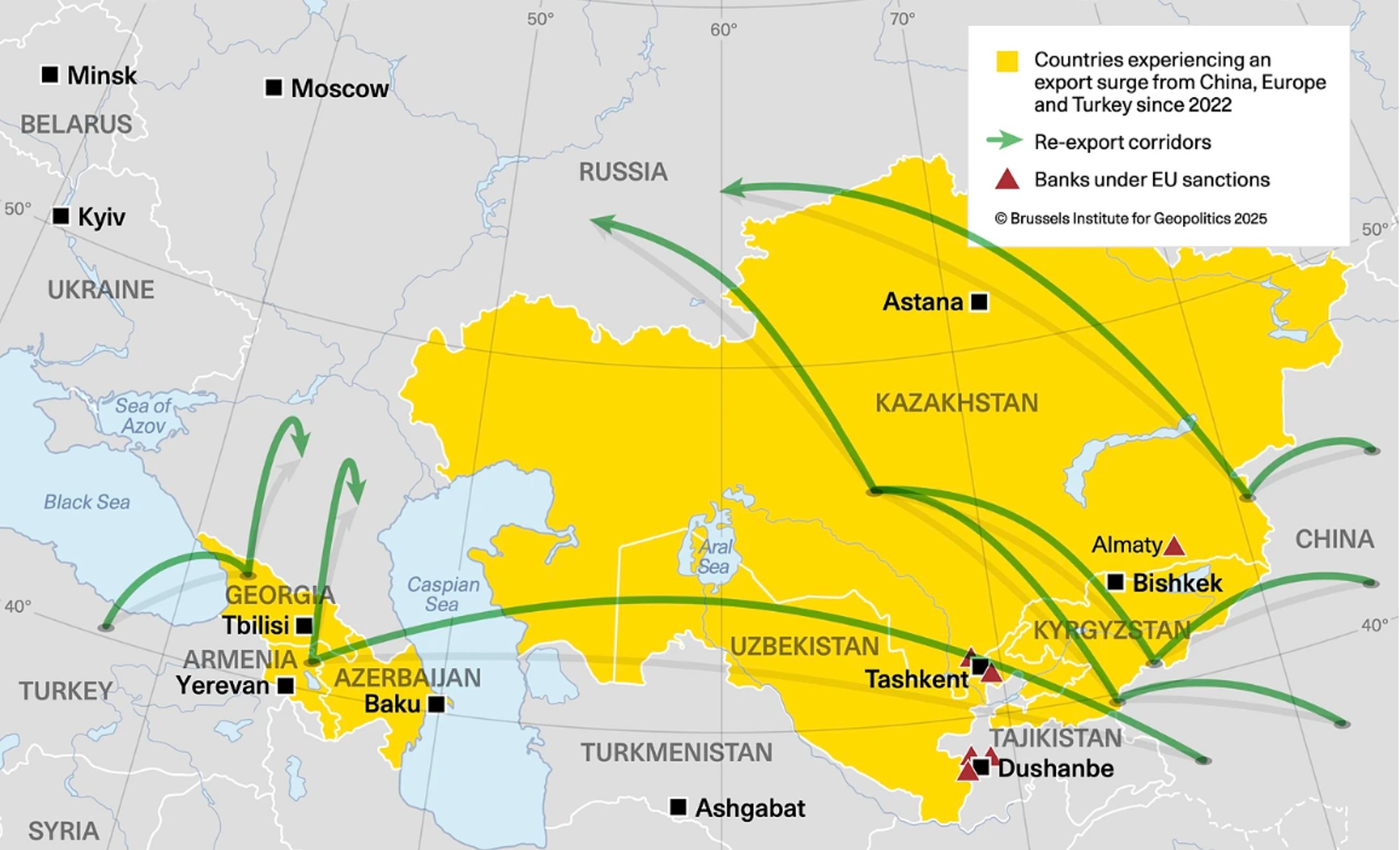
In 2025, the Brussels Institute for Geopolitics documented trade diversion and re‑export schemes involving high‑priority dual‑use goods moving through Central Asia and the Caucasus, supported by false end-user information, free-zone relabelling and shadow-fleet arrangements.[8]https://big-europe.eu/publications/2025-12-18-from-silk-roads-to-backdoors-eu-sanctions-evasion-in-central-asia US enforcement actions have similarly identified transhipment routes used to disguise the destination of controlled goods.[9]https://www.globalsecurity.org/wmd/library/news/russia/2024/12/russia-241202-doj01.htm
These networks often operate through ordinary commercial infrastructure. Consumer appliances such as washing machines, refrigerators and even electric breast pumps, for example, may contain semiconductors, sensors and control systems that can be repurposed for industrial or military use. Sanctions evasion, therefore, extends beyond hidden assets or bank accounts. It relies on concealed relationships across ownership, trade, logistics, technology procurement and payment networks. [10]https://time.com/6226484/russia-appliance-imports-weapons
Research published in the British Journal of Political Science in 2025 also suggests that targeted sanctions may push affected actors further towards opaque offshore services in low-supervision jurisdictions when monitoring and international cooperation do not expand at the same pace.[11]https://www.cambridge.org/core/services/aop-cambridge-core/content/view/AFCA3BBB864CC8F701D549A9B3B4752F/S0007123425101087a.pdf/hide-and-seek-offshore-financial-centers-and-targeted-sanctions.pdf These findings are consistent with wider research by the Brussels Institute for Geopolitics about restrictive measures and EU sanctions evasion in Central Asia as illustrated in this map.
Hostile states and their proxies frequently rely on opaque ownership structures, front companies, intermediaries and cross-border networks to disguise their involvement in commercial activity, technology procurement and financial transactions. These arrangements conceal economic relationships, funding sources and the individuals or entities exercising control. North Korea provides one of the clearest examples. United Nations’ sanctions monitoring and subsequent research have documented the use of front companies, shell entities, trusted intermediaries and maritime networks to obscure involvement in trade, technology procurement and the movement of funds linked to its weapons programmes.
Asset concealment is an enabling capability for drug trafficking, human trafficking, cyber-enabled fraud, corruption and other organised crime. These activities depend on the ability to store proceeds, make payments, acquire assets and reinvest capital without revealing the network behind them. Layering, trade-based laundering and professional nominees can allow illicit economies to scale while preserving access to legitimate markets.
FATF and national authorities have repeatedly found that terrorist organisations rely not only on criminal enterprises, but also on legitimate businesses, charities and financial facilitators to disguise the origin, destination and purpose of funds. Their transnational networks often extend beyond the reach of enforcement authorities, creating risks to both financial integrity and international security.[12]https://home.treasury.gov/news/press-releases/sb0537; https://www.fatf-gafi.org/en/publications/Methodsandtrends/Isil-alqaeda-affiliates-financing-update.html
Illicit funds – whether derived from the proceeds of corruption, tax evasion, sanctions evasion or organised crime – compete with legitimate capital for assets. Where ownership structures and funding sources are deliberately obscured, counterparties may not accurately assess risk, and compliance screening is deprived of the beneficial ownership context it requires. This can disadvantage transparent market participants while allowing opaque actors to externalise risks and costs. Over time, this lack of transparency distorts pricing in sectors like real estate, commodities, and private capital, creating opportunities for market manipulation and insider trading behind layers of shell companies, trusts and nominees.
Asset concealment can make it harder to address human rights abuses and environmental damage. In industries that operate across multiple jurisdictions, ownership and control are often spread across a web of companies, managers, financiers, and intermediaries. As a result, determining who ultimately benefits from, directs, or bears responsibility for harmful practices may be difficult.
The maritime sector provides a compelling illustration of this. Commercial shipping often relies on fragmented operations involving single-purpose vessel-owning companies, technical managers, operators, charterers, recruitment agencies and financiers located across several jurisdictions. In cases involving forced labour, debt bondage, wage theft, excessive working hours or abandonment of seafarers – where crews are left stranded for months without pay, food supplies, medical support, means of repatriation, or in unsafe living conditions – authorities may struggle to trace responsibility through these ownership and contractual chains. While the harm done is visible, accountability remains dispersed and difficult to establish.
Similar challenges arise in relation to environmental harm. Pollution incidents, illegal waste disposal, unsafe shipbreaking practices, and failures to meet environmental standards may be linked to similarly opaque structures when ownership and control are concealed behind layers of corporate and contractual arrangements. In such situations, identifying the parties responsible and securing effective remedies can be far more challenging.
Regulators, investors and other stakeholders increasingly expect firms to identify the ownership, control and economic interests behind their counterparties and supply chains. Failures can result in fines, repayment of profits, external monitoring, restricted market access, higher insurance costs and loss of value.
Ownership opacity and concealed control can create significant reputational risks when harmful practices are exposed. As consumers, investors, and civil society organisations place greater emphasis on ethical sourcing and corporate responsibility, companies linked to exploitative supply chains may face sharp declines in public trust, customer loyalty, and market value. The Boohoo labour scandal is a notable example. Following revelations of poor working conditions and underpayment in parts of its Leicester supply chain, scrutiny focused on the company’s limited visibility over subcontracting arrangements and supplier practices. The fallout was immediate: Boohoo’s share price fell sharply, major investors raised concerns, and the company was forced to increase supply-chain transparency and sever relationships with numerous suppliers. The case demonstrated how opaque supply chains can conceal the relationships and responsibilities behind commercial activity in much the same way as opaque ownership structures can obscure ownership and control. Once exposed, that lack of transparency can quickly cause reputational damage and pressure for greater accountability.
Litigation risk is also increasing. Stakeholders are far more willing to take legal action, including collective and class actions, when they believe a company overlooked certain warning signs. Claims often allege that firms failed to carry out adequate due diligence on counterparties, particularly when red flags such as opaque ownership, high‑risk jurisdictions or unusual payment chains were present but ignored. These cases can lead to costly settlements, reputational damage and, in some instances, personal liability for those who signed off on agreements without adequate due diligence.
For boards, senior executives and compliance leaders, these risks call for an evidence‑based approach. In practice, that means risk owners should:
International initiatives are moving towards faster asset tracing, stronger beneficial ownership information, more effective powers to freeze and confiscate, and better cross-border information sharing. FATF has increased the emphasis on asset recovery and non-conviction-based confiscation,[13]https://www.fatf-gafi.org/content/dam/fatf-gafi/recommendations/FATF%20Recommendations%202012.pdf.coredownload.inline.pdf?nocache=true Interpol has piloted the Silver Notice for tracing criminal assets,[14]https://www.macfarlanes.com/what-we-think/102eli5/interpol-launches-silver-notices-and-framework-targeting-the-proceeds-of-crime-102ju6g/ and the Financial Stability Board has called for more actionable information sharing across payments, crypto-assets and non-bank channels.[15]https://www.fsb.org/uploads/P121224-1.pdf
Ultimately, the rise of cross-border ownership has expanded legitimate investment and innovation but also created new opportunities for concealment. The strategic challenge is to preserve the benefits of international investment and innovation while preventing complexity from becoming impunity. Asset concealment gives criminals, sanctioned actors and hostile states operational freedom by obscuring who controls and benefits from assets. Effective risk management therefore depends on following control and economic benefit across entities, jurisdictions and technologies, and on acting before the separation between legal form and economic reality becomes an enforcement failure. Achieving that increasingly requires investigative capabilities capable of reconstructing ownership and control across fragmented cross-border structures.
Understanding who owns, controls or benefits from assets is becoming increasingly important for organisations operating across borders. HKA’s specialists assist clients with investigations, asset tracing and complex cross-border disputes. Contact us to speak with an investigations expert.
Veronique Foulon has over 15 years of experience in business intelligence, due diligence, risk management, and relevant roles.
Veronique’s expertise includes Foreign Corrupt Practices Act (FCPA) investigations, commercial arbitration, and asset tracing for clients in the aerospace, shipping, and manufacturing industries. She has led numerous pre-transaction due diligence, fraud, and litigation support investigations regarding political corruption, money laundering, and sanction circumvention. She has advised clients about managing third-party money laundering, corruption, and ESG risks.
Fiona Harmsen is an investigator specialising in global complex investigations and cross‑border evidence gathering. She has helped law firms, in‑house teams, and award holders turn incomplete datasets into actionable insight, most often where assets, people, and jurisdictions intersect.
Her expertise includes identifying leverage points to facilitate settlement, identifying and supporting the recovery of assets, and developing strategies to overcome challenges such as sovereign immunity and alter ego arguments. She has successfully evidenced ownership and control of state assets, and contributed to lobbying and communications strategies to strengthen enforcement efforts. Fiona has worked on disputes in sectors such as logistics, mining, construction, energy, and telecommunications.
| ↑1 | https://ofac.treasury.gov/media/913571/download?inline |
|---|---|
| ↑2 | https://www.gao.gov/assets/d24106178.pdf |
| ↑3 | https://cointelegraph.com/news/eu-sanctions-block-russian-crypto-platforms-drone-strikes |
| ↑4 | https://www.fatf-gafi.org/en/publications/Methodsandtrends/Money-Laundering-Terrorist-Financing-Art-Antiquities-Market.html; https://www.gov.uk/hmrc-internal-manuals/economic-crime-supervision-handbook/ecsh54750; https://www.rusi.org/explore-our-research/projects/criminal-risks-free-trade-zones |
| ↑5 | https://www.ft.com/content/2c00ddfa-0d82-4f87-9d0d-35291c0ee2f0; https://news.artnet.com/art-world/3-drug-kingpins-art-adored-316531 |
| ↑6 | https://www.unodc.org/unodc/en/money-laundering/overview.html |
| ↑7 | https://www.clingendael.org/sites/default/files/2025-11/Policy_brief_Thirdcountry_involvement_sanctions_evasion.pdf |
| ↑8 | https://big-europe.eu/publications/2025-12-18-from-silk-roads-to-backdoors-eu-sanctions-evasion-in-central-asia |
| ↑9 | https://www.globalsecurity.org/wmd/library/news/russia/2024/12/russia-241202-doj01.htm |
| ↑10 | https://time.com/6226484/russia-appliance-imports-weapons |
| ↑11 | https://www.cambridge.org/core/services/aop-cambridge-core/content/view/AFCA3BBB864CC8F701D549A9B3B4752F/S0007123425101087a.pdf/hide-and-seek-offshore-financial-centers-and-targeted-sanctions.pdf |
| ↑12 | https://home.treasury.gov/news/press-releases/sb0537; https://www.fatf-gafi.org/en/publications/Methodsandtrends/Isil-alqaeda-affiliates-financing-update.html |
| ↑13 | https://www.fatf-gafi.org/content/dam/fatf-gafi/recommendations/FATF%20Recommendations%202012.pdf.coredownload.inline.pdf?nocache=true |
| ↑14 | https://www.macfarlanes.com/what-we-think/102eli5/interpol-launches-silver-notices-and-framework-targeting-the-proceeds-of-crime-102ju6g/ |
| ↑15 | https://www.fsb.org/uploads/P121224-1.pdf |
This publication presents the views, thoughts or opinions of the author and not necessarily those of HKA. Whilst we take every care to ensure the accuracy of this information at the time of publication, the content is not intended to deal with all aspects of the subject referred to, should not be relied upon and does not constitute advice of any kind. This publication is protected by copyright © 2026 HKA Global Ltd.