Architect’s perspective: Fire safety and digital records in dispute resolution
7th April 2026

This article was originally published in March 2026 edition of the Fire Protection Association Magazine
HKA’s Sarah Keyte considers information management tools which help support the Golden Thread requirements, their benefits, and the typical flaws in dispute resolution which prevent these tools from reaching their potential.
THE BUILDING Safety Act 2022 (BSA) prompted a transformative shift in the approach to building safety in England and Wales, driven by lessons from the Grenfell tragedy. It introduces new responsibilities and oversight mechanisms, and promotes a cultural shift toward greater accountability and transparency, to ensure building design and construction comply with safety regulations, particularly around fire safety.
Central to the reforms introduced by the BSA, and the secondary legislation, is the ‘Golden Thread’, a structured, digital record of safety-critical information produced during the design and construction of a building and maintained throughout a building’s lifecycle. While the Golden Thread is often discussed in terms of regulatory compliance, its real significance increasingly lies in how digital records frame accountability and evidence in future disputes. In other words, the Golden Thread ensures that accurate, accessible, and up-to-date safety information is available to all stakeholders – from designers and contractors to building owners and regulators. It also supports accountability (who did what, when and how), transparency (ensuring that safety decisions are based on reliable data), and continuity (that is, preservation of knowledge during ownership changes and building phases).¹ Generally speaking, the Golden Thread is critical for making informed decisions relating to fire safety throughout a building’s life cycle.
This article discusses common data environments and information management tools marketed as aiding Golden Thread compliance.
Common data environments
ISO 19650-1 defines a common data environment (CDE) as the “agreed source of information for any given project or asset, for collecting, managing and disseminating each information container through a managed process”.² In simple terms, project stakeholders use CDEs to share, store, and manage project information. CDE guidance is available for free on the UK BIM Framework website.³ CDEs are now mandatory in public sector projects and increasingly recognised as a cornerstone of good information management.⁴
Section 88 of the BSA introduces the requirement to keep and update the relevant information about Higher-Risk Buildings (HRBs), but it does not specify the format or any particular technology that must be used to comply with the Golden Thread. The secondary legislation provides further guidance on how to prepare or structure the Golden Thread.⁵ In summary, the information needs to be digital, accessible and easily transferable, accurate and up-to-date, secure, intelligible to the intended users, and consistent in language, terminology, and definitions.
Benefits of CDEs to projects
CDEs are typically intended to act as a single source of truth for project information. At its most basic, a well organised CDE makes it easier to find key information. This is beneficial to all parties. CDEs can ensure project stakeholders are working from the appropriate revisions of drawings, models, schedules, and documents. This is typically done using cloud-based platforms, allowing parties to collaborate remotely.
CDEs can help promote accountability. Defined workflows can make it obvious who owns each document, approval, or revision. As a result of improvements in data analytics, CDEs (and the dashboards they can host) can provide insights into critical activities and help identify potential risks. A dashboard may highlight overdue Requests for Information (RFIs) to the user responsible for responding to them.
It is difficult to quantify the return on investment for CDE implementation. A 2021 KPMG report suggested that for every £1 invested in information management, between £5.10 and £6 of direct labour productivity gains could be made.⁶ However, in our experience, when setup and managed well, a well-organised CDE can help project stakeholders manage information and work efficiently. This prevents re-works, which is beneficial to all project stakeholders.
In addition to document management, some CDEs are capable of hosting models, aiding clash detection and coordination efforts.⁷ This can help democratise Building Information Modelling (BIM), by allowing the wider project team to work collaboratively without the need for proprietary software.
Benefits of CDEs during dispute resolution
Under the Civil Procedure Rules Part 35 (CPR Part 35), an expert’s overriding duty is to give the court an independent opinion on matters within his/her area of expertise. Expert witnesses do not have first-hand experience of the projects they give opinions on. A well-managed,detailed CDE can give insights into who did what, when, (and sometimes how and why). In our experience, this can give useful, factual, contemporaneous evidence, which is preferable to conjecture.
In fire engineering disputes, expert witnesses may use CDE records to understand how the design evolved over ime and verify claims made by parties. For example, CDE records may show: when files were uploaded; authors; download logs; workflows; comments; and approvals or rejections. This enables construction of clear timelines and can aid understanding of the project, including the decision-making process relating to fire safety aspects of the project.
When asking HKA experts about their experiences working with CDEs, the largest CDE issued to our team housed over one million files. These were related to a major citywide infrastructure project. Files had been produced over a ten year period by more than thirty designers, consultants, contractors, and subcontractors. Documents could be searched by discipline, date, status, document number (all of which followed consistent naming conventions), description, or content.
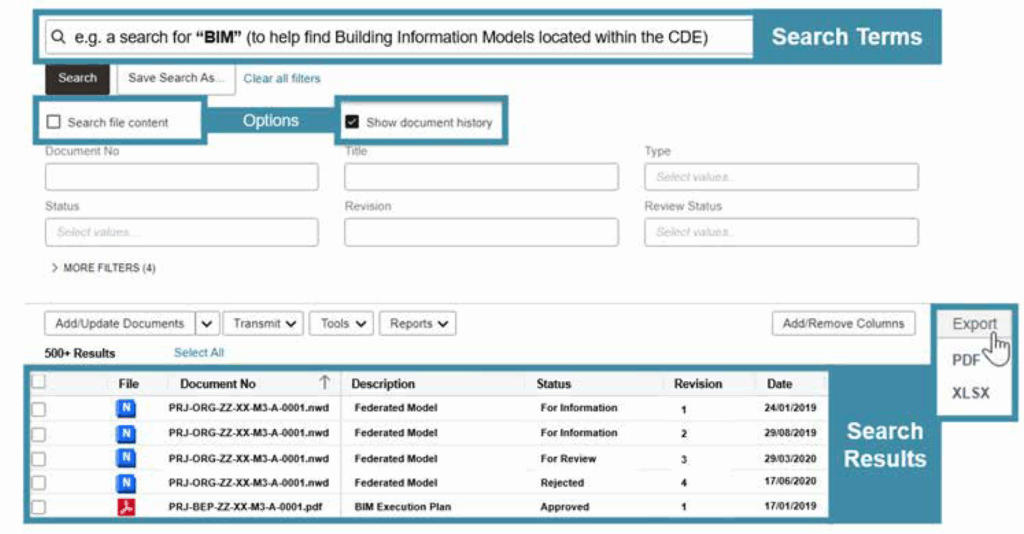
Many popular CDE solutions mention the Golden Thread in their product marketing (e.g. Autodesk construction Cloud⁸, Asite⁹, and Zutec10, to name a few). As shown in Figure 1, records from the CDE platform can often be extracted into excel.
Many CDEs have useful audit trail functionality. Aconex, a popular CDE, describes how “the Aconex audit trail records the changes made to documents, mail and reports in Aconex. It lets you see who was responsible for which decisions”.¹¹
CDE records may be used by experts to check whether the data trail in the CDE aligns with claims. These records may be used to visualise a timeline of when each party shared do cuments, and what the approval timeline looked like. This can give a holistic view of the project design and can aid the court/tribunal in better understanding of the project. CDE event log records can also be used for more granular purposes. For example, event logs may be used to track who viewed, edited, or downloaded a particular document and when.¹²
This data trail makes it easier, for example, to demonstrate that a party was or was not aware, or should have been aware, of key facts or documents at some particular point in time.
A poorly managed CDE can also be useful in dispute resolution, especially if standard of care or breach of contract claims relate to information management.
What can go wrong with CDE records?
There is a significant disparity in the quality of records we uncover during our forensic investigations. However, most failures are not technological, they are contractual, behavioural, or governance-related.
- Choice and management of CDE: Not all records are created equally – and the same applies to the various CDEs available on the market, as well as the quality‑control procedures governing them. In our experience, some CDEs have a better audit trail functionality than others, so choice of CDE impacts quality of records. For example, one CDE solution analysed in our research did not support the extraction of detailed records.
- Writing in the sand: Not all records are permanent – a party may have used a CDE during the project, but may not have downloaded records from it. While this can be rectified if the CDE is still functional, a CDE may be shut down after project completion. Records can be lost, or difficult to recover. At the outset of the project, it is arguably prudent to agree who controls the CDE, who will have access to it in future, and in what circumstances as part of the contract documents. However, this often is not the case.
- Contractual uncertainty: Construction contracts often do not specify what happens to a party’s CDE access in the event of a dispute. While clause 5.5 of the ISO 19650 protocol¹³ states that the noncontrolling party will have “…reasonable access to the information in the CDE Solution and workflow…insofar as necessary to perform its obligations…”, this language is open to interpretation.
The party who controls the CDE can be a powerful gatekeeper. CDE access may be rescinded by the CDE controller if a dispute arises. Akin to the scenario in Trant Engineering Ltd v. Mott MacDonald Ltd [2017] EWHC 2061 (TCC), where a client sought an injunction to gain access to the CDE, access for non-controlling parties can be uncertain and potentially unstable.
This issue can be frustrating in disputes, as one team of experts may have access to the CDE, and the opposing experts may be forced to work without it. Having been on both sides of this issue, it is typically preferable to have CDE access. - Digital skills gaps: Similarly, many construction lawyers remain unaware of the benefits CDE records can have in dispute resolution. Without improvements to digital understanding, lawyers may not appreciate the importance of advising clients to preserve CDE records.
However, having observed a lawyer successfully navigate the employer’s CDE and BIM models to substantiate claims, it is evident that those who invest in developing these skills may present more compelling arguments, particularly as digital transformation continues to expand the range of available evidence. - Permissions vary: Depending on who controls the CDE (usually a client or a contractor), permissions of other parties (e.g. subcontractors) may vary. A as a main contractor. This may leave a subcontractor in a less advantageous position when pursuing claims. This raises a question whether the model should be under the ‘ownership’ of the project rather than an individual party.
- Importance of backups: It is prudent for each project stakeholder to download records from the CDE and ensure copies of documentation uploaded to the CDE are backed up to an accessible domain under its own control. This gives each business control if relations break down. While this safety measure increases the cost of data storage, they are often negligible in relation to the cost of legal fees.
How might these tools improve in the future?
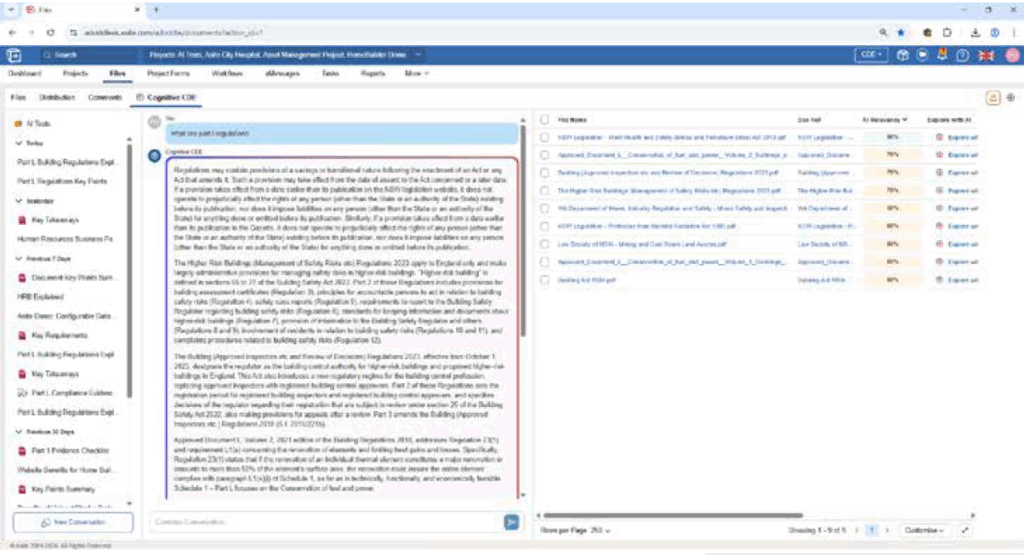
As artificial intelligence tools continue to be integrated into CDEs, some service providers are bringing Large Language Models (LLMs) into their platforms. For example, in May 2025, Asite announced their “Cognitive CDE”.¹⁴ As shown in Figure 2, among other functions, this tool answers users’ questions using project data and attempts to identify relevant documents. This is arguably a significant step towards making project information more accessible, particularly on complex projects with extensive documentation.
In practice, the potential value of such tools becomes clear when considering the types of searches that can be undertaken. In fire engineering related disputes, the searches would include drawings, specifications, designdecision records, change control procedures, review and approval logs, inspections records and on-site reports highlighting quality issues, clashes, etc. These are the types of information that parties currently obtain through e-discovery platforms, usually after additional steps of exporting, downloading, and re-uploading data. An LLM embedded within the CDE could in principle perform similar tasks, reducing this administrative burden and, maybe in the future, enabling targeted questions such as: “Who approved the compartmentation details and when?”.
While a discussion on LLMs in expert evidence is a topic worthy of its own article, LLM outputs will still require careful validation before they can be relied upon in an expert’s analysis.
Due to the delay between technology adoption during construction and the time typically taken for claims to arise, it may be some time before experts are given access to a CDE with integrated AI tools. However, in the context of Golden Thread compliance, such tools can help the project team to quickly locate safety-critical information across a large volume of design, construction, and maintenance records. By enabling accurate and transparent retrieval of project information, LLMs may help strengthen the continuity and accessibility of information required by the BSA.
Conclusion
CDEs are transforming how the construction industry manages and preserves project information, including the installation of fire safety elements and data trails relating to fire safety design.
When implemented correctly, CDEs can support Golden Thread compliance by producing accurate and accessible records. They not only enhance accountability and transparency in the context of the BSA, but also provide great evidential value in dispute resolution. In practice, this means navigating through safety-critical information quicker and, with integrated AI tools, in a more targeted way. As with any emerging technology, effective use of a CDE requires correct setup and proactive quality control over information management.
The future is already here for those who already benefit from data-rich record trails. For others, records may not feel as important until it is too late. The quote “A party to a dispute… will learn three lessons (often too late); the importance of records, the importance of records, and the importance of records”¹⁶, underlines the importance of record keeping for the purposes of forensic investigations. Adequate digital records often enable experts to reconstruct decisions, timelines, and installation quality (what was done, by who, where, and when). This ability to work efficiently can lower the cost of legal fees and expert opinions in dispute resolution.
Depending on whether a CDE was set up and managed appropriately, experts may find themselves swimming gracefully in a data lake or laboriously wading through a data swamp. Whilst both can generate useful, factual, contemporaneous evidence of performance, the construction industry should treat digital information management as a shared responsibility. Owners and clients need to drive governance and CDE adoption, and require clear accountability for data quality across the supply chain. Contractors and designers should prioritise the quality of the information they produce, including accuracy, completeness, and permanence of the records. The information should be treated as part of the built asset and not as an administrative burden or afterthought. Lawyers and experts should engage with digital evidence at an early stage to understand the structure and audit
trails within CDEs as a means of strengthening the quality and reliability of the evidence.
Alongside the benefits, there are some challenges with digital records. To realise the potential, digital skills in the industry (from operatives to legal teams) need to improve, and both operatives and overseeing staff will need appropriate training in the use of new technology. Furthermore, contracts will need to evolve to specify how we capture the useful trails of digital breadcrumbs, enabling future building users to follow the paths taken by project participants.
The technology needs to be driven forward by competent professionals, however, technology may only help us work efficiently if contracts give us the necessary access and permissions.
Footnotes
- https://buildingsafety.campaign.gov.uk/building-safetyregulator-making-buildings-safer/building-safetyregulator-news/understanding-the-golden-thread/
- ISO 19650-1: 2018 ‘Organization and digitization of information about buildings and civil engineering
works, including building information modelling (BIM) – Information management using building information modelling. Part 1: Concepts and principles’, 3.3.15. - https://imiframework.org/standards/
- https://assets.publishing.service.gov.uk/media/6312222de90e075880923330/14.116_CO_
Construction_Playbook_Web.pdf - For example, The Higher-Risk Buildings (Management of Safety Risks etc) (England) Regulations 2023, Regulation 7; The Building (Higher-Risk Buildings Procedures) (England) Regulations 2023, Regulation 31.
- https://assets.kpmg/content/dam/kpmg/uk/pdf/2021/06/cdbb-econ-value-of-im-kpmg-atkins-main-report-new.pdf
- https://construction.autodesk.com/resources/accvideos/2d-3d-walkthrough-3/
- https://www.autodesk.com/blogs/construction/maintaining-the-golden-thread-part-1/
- https://www.asite.com/blogs/what-is-the-golden-threadof-information
- https://zutec.com/resources/golden-thread-cde-in-usebuildings-booklet
- https://help.aconex.com/documents/how-do-versioncontrol-and-the-aconex-audit-trail-work/
- https://help.aconex.com/documents/view-the-event-logto-see-which-users-have-accessed-or-changed-a/
- https://ukbimframework.org/wp-content/uploads/2020/06/Information-Protocol-to-support-BSEN-
ISO19650-2.pdf - https://www.asite.com/news/cognitive-cde-release
- https://www.asite.com/hubfs/Cognitive%20CDE%20mockup%20for%20two%20pager%202-1.png
- Max W Abrahamson, Engineering Law and the ICEContracts, 4th Edition Applied Science Publishers 1979.
About the authors

Sarah is a chartered construction manager and testifying expert witness specialising in information management and building information modelling. She uses digital tools to aid construction dispute resolution. Sarah holds a MSc in C onstruction Law and Dispute Resolution, was recognised by Autodesk in their annual global ‘40 under 40’ awards program, and is a Lexology ‘future leader’.
This publication presents the views, thoughts or opinions of the author and not necessarily those of HKA. Whilst we take every care to ensure the accuracy of this information at the time of publication, the content is not intended to deal with all aspects of the subject referred to, should not be relied upon and does not constitute advice of any kind. This publication is protected by copyright © 2026 HKA Global Ltd.