


Article

This article focuses on three key themes that are increasingly affecting data center construction projects:
Together, these factors contribute to a growing risk of delays, cost overruns, reduced performance, and disputes across large-scale data center developments.

The global expansion of data center development has emerged as a defining infrastructure effort of the digital era, often compared to a modern Manhattan Project for its scale, strategic importance, and concentration of capital. The United States is leading this expansion, driven by hyperscale cloud providers and the rapid growth of artificial intelligence, and is expected to attract hundreds of billions of dollars in investment this decade. Other regions, including Europe, Asia Pacific, and the Middle East, are accelerating efforts to attract comparable infrastructure investment. However, this unprecedented investment has not translated into smooth delivery. Power constraints, supply chain limitations, permitting challenges, and local opposition are increasingly disrupting construction schedules, causing many publicly announced completion dates to prove unrealistic and leaving a growing share of projects facing delay or uncertainty.
Like other major infrastructure developments, data center projects are inherently prone to disputes due to their scale, technical complexity, and demanding schedules. Equipment and labor availability, interfaces with third parties such as state and local governments and utilities, and design changes are additional challenges that data center projects now face. Many disputes remain confidential to preserve investor confidence and market perceptions, while others become more visible when construction, regulatory, or investor-related claims lead to litigation. The nature and scope of these disputes are often not publicly disclosed, in part because non-disclosure agreements limit the industry’s ability to share best practices and learn from others’ experiences. Nevertheless, with ongoing development and industry attention, “lessons learned” are starting to circulate among stakeholders.
This article examines how the distinctive characteristics of large-scale data center projects shape the disputes that arise. It also analyzes practical avenues for anticipating, managing, and resolving conflict in an era where digital infrastructure has become nationally and economically strategic. We discuss a series of hypothetical scenarios that have affected data center construction, leading to delays and impacts, as well as trends in the enforcement of liquidated damages (LD), and mitigation frameworks. The hypothetical scenarios set forth in this paper draw on both publicly available information and the experience of the authors and others at HKA. They are intended for informational purposes only and should not be construed as legal advice, as the specific facts, contract documents, project records, or applicable ordinances governing each project may lead to different outcomes.
A hyperscale developer began construction of a new data center campus designed to support approximately 300 MW of critical IT load, with the facility originally intended to connect directly to the regional power grid. Early development assumptions relied on timely utility upgrades and a regulatory environment that had historically supported rapid interconnection for large industrial users. As the project advanced, however, a combination of grid congestion, evolving utility interconnection requirements, and regulatory changes significantly delayed the availability of permanent power beyond the developer’s commercial requirements.
In response to mounting uncertainty around grid connection, the developer evaluated on-site generation solutions, exploring both interim and long-term strategies. Initial designs contemplated the use of natural gas-based generation and standby diesel generators to support both primary and backup power needs. These systems were selected based on the developer’s project experience and the perceived ability to deploy them more quickly than waiting for the utility issues to be resolved. As procurement efforts progressed, however, the developer encountered substantial lead-time challenges. Manufacturing queues for gas turbines had expanded materially due to global supply chain disruptions, increased demand from infrastructure and energy projects, and heightened scrutiny of emissions and permitting. Delivery timelines for certain major components extended well beyond what the project schedule could absorb without causing delays and increasing costs.
Compounding the timing challenges, regulatory requirements governing emissions thresholds and operational permitting continued to evolve throughout development. Design packages that were initially compliant required revision, triggering additional review cycles and further eroding schedule certainty. While the project team attempted to mitigate these impacts by resequencing construction activities and partially building out non-power-dependent infrastructure, progress in this instance was constrained by the lack of a viable long-term power solution. Key activities related to core infrastructure could not advance meaningfully without greater clarity on the generation strategy. These issues were compounded by ongoing workforce shortages, as the specialized labor required to install energy systems was not readily available. The combination of design uncertainty and labor availability raised questions about the critical path while the project team struggled to resolve both issues.
Faced with protracted lead times for natural gas turbines and ongoing uncertainty regarding grid interconnection approvals, the developer ultimately reassessed its power architecture. Alternative technologies with shorter deployment timelines and a more favorable regulatory profile were considered, leading to a pivot toward fuel cell-based solutions. A fuel cell is a non-combustion electrochemical device that converts the chemical energy of a fuel into electricity through a chemical reaction without burning the fuel. Although fuel cells introduced design, integration, and commercial complexities, they offered a pathway to mitigating schedule delays by reducing reliance on contested grid upgrades and constrained power generation equipment manufacturing capacity.
This midstream strategy shift required a substantial redesign of the electrical and mechanical systems, a revision of procurement packages, and a renegotiation of scope responsibilities across multiple project participants. Although the alternative approach reduced the forecasted duration to energization, the cumulative effect of grid interconnection delays, generation lead-time expansion, and regulatory changes had already materially extended the overall project duration. The numerous changes to the mechanical, electrical, and plumbing (MEP) systems also led to commissioning issues, as the original plan had long since become obsolete.
The project was ultimately completed significantly late, impacting the developer’s ability to turn over the project to the owner. Schedule experts were retained to analyze the schedule delays, including identifying the critical path and the causes. The contractor’s expert identified a critical path that ran through the various changes in the developer’s strategy to power the project, emphasizing that the final design underwent numerous revisions to reflect changing market conditions and that these design changes were the developer’s responsibility. The developer’s expert opined that once construction started, the critical path was largely within the contractor’s control and its issues with labor availability and commissioning offset, or in some cases exceeded, any project design issues. A high-level comparison of both sides’ perspectives are illustrated in Figure 1.
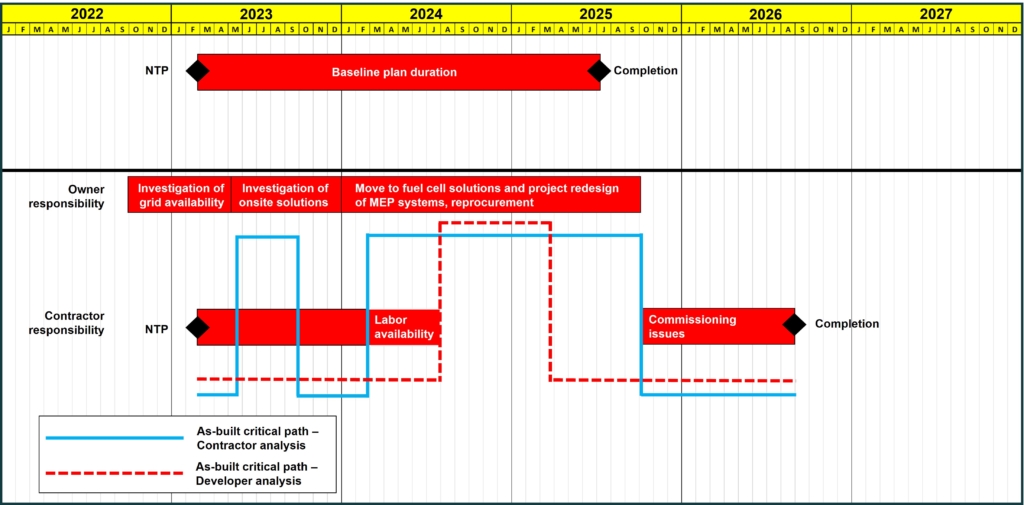
Under the contract, the contractor faced LD penalties of $5,000 per day after a 45-day grace period, capped at 10% of the contract value ($200 million). The contractor attempted to highlight the developer’s delays to defend against the LDs and pursue its own delay claims, including recovery of its additional time–related damages, while the developer pursued a similar strategy of seeking to enforce LDs for the delay the project experienced. The dispute proceeded to arbitration, where each side relied on contemporaneous documentation, schedule updates, deposition testimony, and a voluminous set of correspondence, photographs, and other records to demonstrate the project’s critical path.
A large-scale colocation developer undertook construction of an approximately 120-MW data center facility in Texas. The Texas market has significant infrastructure development projects underway, and competition for skilled trades can be fierce. In an effort to accelerate procurement and manage rising construction costs, the general contractor selected subcontractors whose pricing and labor availability were competitive but whose prior experience with data center projects was limited.
During preconstruction, the electrical subcontractor forecasted a peak labor demand of approximately 150 electricians to support the concurrent installation of medium-voltage infrastructure, power distribution systems, standby generation, and uninterruptible power supply equipment. As construction progressed, several large commercial and infrastructure projects broke ground in the same labor market, severely constraining the availability of qualified electricians. Despite offering incentives such as sustained overtime, premium pay rates, and staggered shifts, the contractor consistently staffed only 60 percent of its projected peak-demand workforce.
These labor shortages not only directly affected installation productivity but also significantly impacted the quality of the work performed. To backfill for unavailable skilled labor, the subcontractor increasingly relied on personnel with little to no experience in data center environments. This resulted in widespread installation deficiencies, including improper terminations, noncompliant grounding, undocumented field changes, and incomplete testing documentation. Inexperienced supervision also failed to deploy crews efficiently, resulting in many lost hours while crews were sidelined and unproductive. Many installations failed to meet applicable codes, design specifications, and manufacturer requirements, triggering repeated punch lists and rework cycles.
As the project transitioned toward commissioning, these quality issues became acute. Commissioning activities could not proceed as planned due to open electrical deficiencies, failed inspections, and unresolved discrepancies between the as-designed and as-built conditions. Multiple systems that were nominally “installed” were not commissionable, forcing the activities to be paused, resequenced, or repeated. The owner asserted that commissioning delays were driven not only by manpower shortages but also by the cumulative effects of poor workmanship, inefficient supervision, and the general contractor’s unfamiliarity with data center-specific performance and documentation standards.
The general contractor blamed the electrical subcontractor for the full extent of the delay. In turn, the electrical subcontractor argued that unprecedented labor market conditions constituted an external constraint and that owner-driven changes and accelerated milestones exacerbated workforce challenges. However, project records demonstrated a persistent misalignment between the complexity of the work and the qualifications of the labor force.
By the time corrective measures were implemented, including increased oversight, selective replacement of crews, and targeted reinstallation of critical systems, the project had accumulated significant schedule delay and cost overruns. The delay affected turnover milestones, tenant handover commitments, and commercial operations. The dispute ultimately required detailed schedule and productivity analyses to distinguish delays attributable to labor market conditions from those resulting from contractor selection, experience gaps, and execution quality.
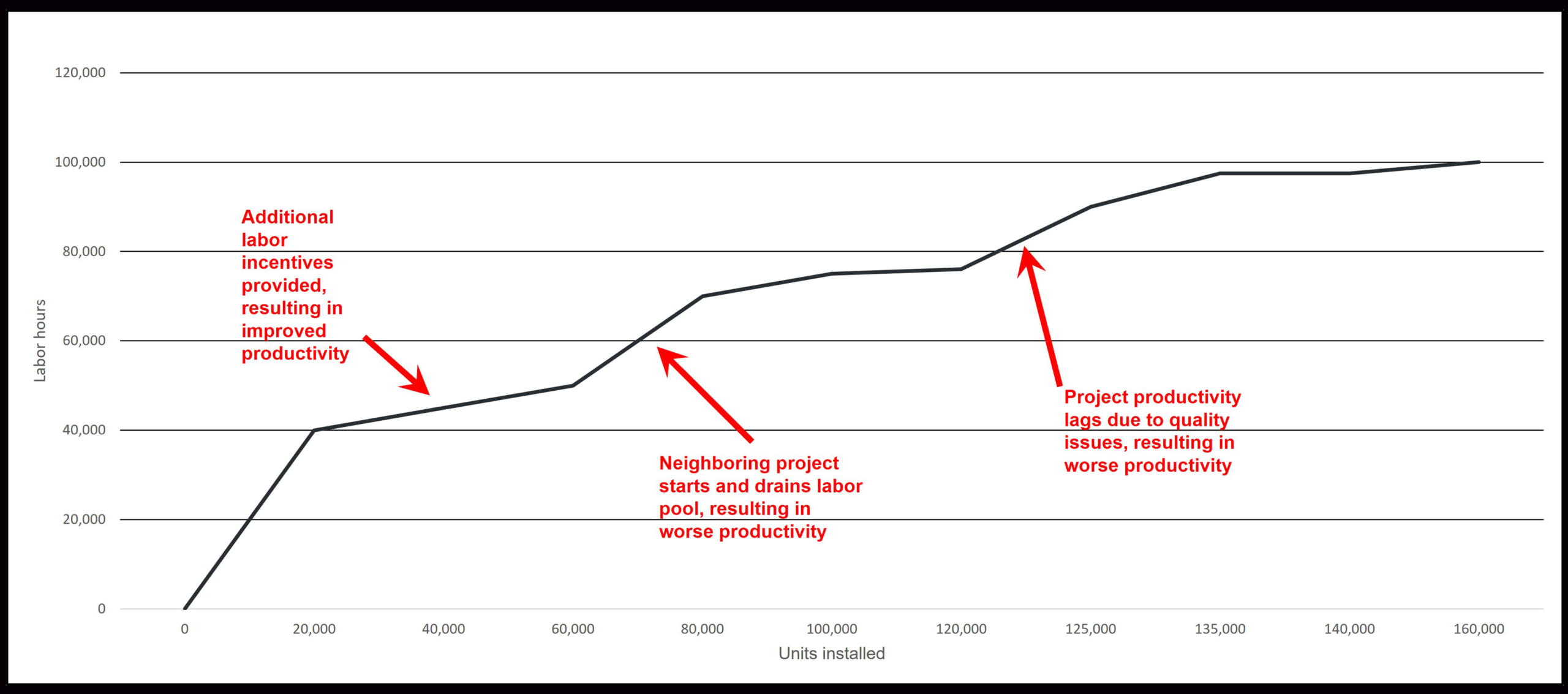
In support of its position, the electrical subcontractor prepared a labor productivity analysis to quantify the impact of the various issues on productivity. Specifically, it performed a measured mile analysis, illustrated in summary in Figure 2. A measured mile analysis typically examines labor productivity by reviewing the actual productivity achieved on the project and comparing it across impacted and unimpacted periods to quantify the impact of issues. One advantage of a measured mile analysis is that it uses the actual productivity demonstrated on the project as the basis for comparison, addressing potential issues that may be raised, such as the contractor’s bid assumptions. The parties disputed aspects of the analysis, raising questions about the mechanics of the calculation, the timing of events, and the responsibility for labor. Ultimately, the productivity analysis provided a basis for understanding the impacts and served as a starting point for successful negotiations.
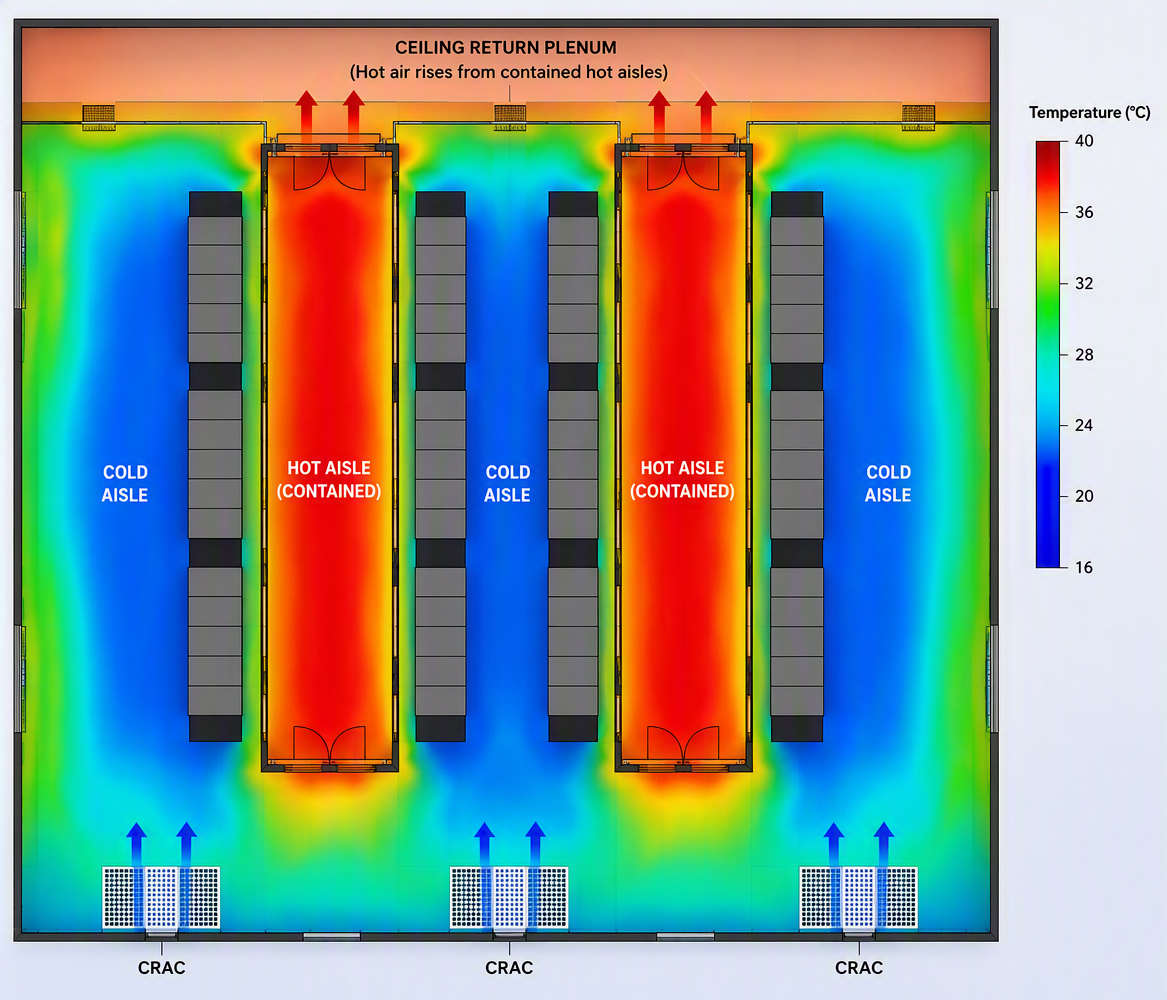
An 80-MW data center project was developed under a mechanical design led by the engineer of record. The mechanical design basis specified a particular computer room air-conditioning (CRAC) unit model with defined airflow capacity, sensible heat ratio, fan performance curves, and control integration to support a hot aisle containment strategy at full design load, as shown in Figure 3. The design documentation explicitly stated that no substitutions would be permitted without written approval from the engineer of record to ensure compliance with the overall thermal model and redundancy assumptions.
Midway through construction, the mechanical contractor proposed an alternative CRAC unit manufactured by a different vendor. The mechanical subcontractor, motivated by lower costs, asserted that the substitute unit could be procured at a significantly shorter lead time than the specified equipment, which had become subject to extended manufacturing delays. Based primarily on the asserted schedule benefit and without formally routing the substitution through the engineer of record, the general contractor and owner approved the change in hopes of maintaining the overall construction timeline and avoiding further disruption.
Although the substituted CRAC units met nominal cooling capacity ratings on a per-ton basis, they differed materially in airflow delivery per unit, fan static pressure capability, and control response characteristics. These differences were not reassessed against the project’s HVAC load calculations or the assumptions embedded in the hot aisle containment design. As installation progressed, the substituted units were integrated into the project with minimal changes to the downstream distribution, containment, or control logic.
The impact of the substitution did not fully materialize until commissioning and integrated systems testing. During staged load testing, cold aisle supply temperatures proved uneven, and several rack locations experienced localized hot spots well above the allowable thresholds for the deployed IT hardware. Operators determined that the airflow delivered by the substituted CRAC units was insufficient to overcome pressure losses in the containment system at higher power densities, resulting in inadequate heat removal at the design load.
As a result, the facility was unable to operate at its intended critical load without exceeding the recommended inlet temperature limits, which forced a derating of IT capacity and delayed tenant occupancy. Commissioning activities were suspended while the project team investigated the root cause of the thermal underperformance. Responsibility for the failure became a subject of dispute, with the contractor pointing to owner-directed approval of the equipment change, the owner asserting reliance on the contractor’s representations regarding equivalency, and the engineer of record denying responsibility for equipment selections that were made without their review or approval.
Ultimately, the project was completed 6 months late, with a remediation strategy based on a reconfiguration of containment. The contract’s uncapped $100,000/day LD clause resulted in nearly $20 million in potential penalties against the contractor, as well as significant delay claims against the owner.
The owner initiated the change to accommodate the latest designs but faced tenant lawsuits over delayed occupancy on the one hand and delay claims from its contractor on the other. Faced with litigation on two fronts, the owner moved to resolve the contractor’s lawsuit first by attempting to draw in its engineer’s errors and omissions insurance to cover a portion of the delay claims while tolling the litigation with the tenants.
The insights and scenarios presented in this white paper demonstrate that data center development and construction are defined by a complex and evolving risk landscape. Power strategy shifts, skilled labor shortages, and unverified design substitutions illustrate how technical issues can rapidly lead to cost overruns, schedule delays, reduced performance, and escalated disputes. To mitigate these risks, stakeholders should move beyond assumptions of linear delivery and instead adopt proactive, data‑driven approaches to risk identification, monitoring, and response. With a better understanding of how emerging risks translate into delay, cost, and dispute exposure, stakeholders can more effectively manage uncertainty, preserve value, and navigate conflicts when claims and disputes arise.
HKA helps project stakeholders navigate the technical, schedule, and commercial challenges that frequently arise on large-scale data center developments. Drawing on expertise in construction, engineering, forensic technical analysis, scheduling, and damages assessment, HKA analyzes the causes and consequences of grid interconnection delays, equipment procurement constraints, labor shortages, productivity losses, workmanship deficiencies, commissioning challenges, and design changes. Our experts compare baseline assumptions with actual performance, identify critical path impacts, quantify delay and disruption damages, and assess the reasonableness of project decisions and risk mitigation measures. Where performance issues emerge, HKA’s forensic engineers investigate installation quality, code compliance, commissioning readiness, and system functionality to determine root causes and resulting impacts. By integrating technical, schedule, and financial analyses, HKA provides independent expert insight that helps owners, developers, contractors, lenders, and counsel understand project outcomes, manage risk, support claim development and defense, and help resolve disputes through negotiation, mediation, arbitration, or litigation.
Learn more about our Data Center experience.
HKA also helps clients navigate intellectual property issues associated with data center technology and AI generally. This includes assessing damages in patent infringement, copyright, and trade secret misappropriation matters involving both hardware and software. Some examples of relevant HKA IP experience include technologies such as FPGAs, CPUs, GPUs, memory, network configurations and management, network software, power management, cooling systems, LLM training, and AI.
Learn more about our related Intellectual Property experience and services.
This publication presents the views, thoughts or opinions of the author and not necessarily those of HKA. Whilst we take every care to ensure the accuracy of this information at the time of publication, the content is not intended to deal with all aspects of the subject referred to, should not be relied upon and does not constitute advice of any kind. This publication is protected by copyright © 2026 HKA Global Ltd.