Interview

Discover how curiosity, persistence and investigative thinking led Fiona Harmsen from France to art crime expertise and complex investigations. In this engaging Q&A, Fiona shares her career journey, specialist interests and advice for aspiring investigators

Fiona Harmsen is a Senior Managing Consultant in HKA’s Investigations practice and is based in London.
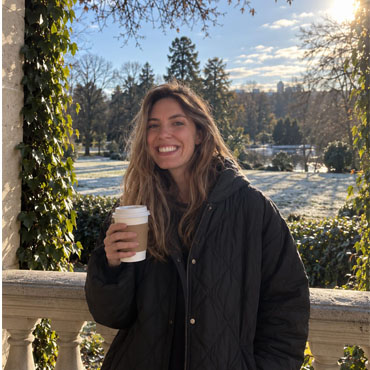
From uncovering hidden issues for clients and piecing together complex information to developing specialist expertise in art crime and provenance research, Fiona has built a career around curiosity, persistence and asking the right questions.
Recently, Fiona completed Sotheby’s Institute of Art’s Art Crime course with a perfect score, placing her among the top-performing participants since the program was launched. We spoke with Fiona about her career journey, what attracted her to investigations, her achievement and why HKA’s collaborative culture makes it a stand-out place to work.
Fiona, tell me about your background.
I grew up in a small town in France, surrounded by countryside and fields. When I was 19, I moved to London to learn English and spent my first year working various jobs while studying International Relations and Security at university.
It was during my studies that I discovered investigations as a career path. One of my lecturers introduced me to the idea of investigations in the private sector, which was something I hadn’t really come across before. At the time, it felt like discovering a vocation I had always been interested in, but never knew actually existed.
I’ve now spent six years working in investigations and joined HKA’s growing Investigations team in December 2025.
What attracted you to your speciality?
I’ve always been an inquisitive person. As a child, I was constantly asking questions, solving riddles and trying to figure things out.
What I enjoy most about investigations is that every case is different. Often, you start with very little information, or with a client who has a working hypothesis about the problem they’re facing. As investigators, our job is to gather information, make sense of it and, sometimes, uncover a completely different issue than the one originally expected.
I enjoy the challenge of identifying and connecting information, building a picture from different sources and finding answers to complex questions. There is always something new to learn, which keeps the work interesting.
You recently completed Sotheby’s Institute of Art’s Art Crime course with an outstanding result. Can you tell us about that experience?
The course was a 12-week program covering a wide range of topics, including art crime, provenance, due diligence and the broader risks affecting the art market.
I’ve always had an interest in the sector, but it was an opportunity to develop a much deeper understanding of the challenges surrounding ownership, authenticity and high-value cultural assets. Some of the topics were completely new to me, while others closely reflected the investigative work we already do for clients.
While achieving that result was incredibly rewarding, the real value came from the knowledge gained and the connections made throughout the course.
There is a strong overlap between these principles and the work we do at HKA. Whether investigating art, luxury assets or corporate matters, the core disciplines of provenance research, due diligence, asset tracing and fact-finding are fundamentally similar.
The course has also given me an opportunity to consider how that expertise could create value for HKA. I will share what I’ve learned with my colleagues as we explore opportunities to build relationships within the sector. There is a growing overlap between the art world and areas such as fraud, contested ownership, asset recovery and complex investigations, so it’s an exciting space to learn more about.
Why is HKA a stand-out employer for you?
For me, it’s the culture. There’s a genuine sense of collaboration, trust and support across the business, and that’s not limited to one team or department. It’s something I’ve experienced throughout the company.
Our work can sometimes be demanding and high-pressure, so being part of an environment where people are willing to share knowledge, support one another and help solve problems makes a real difference. I feel that I am part of a team, even when I am personally responsible for delivering a particular piece of work.
I also think people at HKA are genuinely passionate about what they do. Everyone is happy to share their expertise, and that creates a culture where people can learn from one another and continue to grow. I am not expected to know everything technical, but my investigative perspective is trusted and valued. I can ask questions, contribute my own judgement and continue learning from people across the business.
Is this a career path that you had originally set out to do? As a teenager, what did you want your career to look like?
Yes and no. Like many people, my career ambitions changed several times while I was growing up.
When I was very young, no older than six, I had a very specific ambition: I wanted to work in a circus with white horses. I am not entirely sure what qualifications I thought the role required, but the white horses were non-negotiable. Later, as a teenager, I wanted to become a vet, although mathematics and I never quite became friends.
Investigations wasn’t something I had planned from an early age. It was only when I learned that private-sector investigations existed that everything clicked into place. Looking back, it feels like a natural fit because it combines the curiosity and problem-solving that I’ve always enjoyed.
What are your passions outside of work?
I am a very simple person. I don’t necessarily have one defining passion, but I enjoy lots of different things and find happiness in simple pleasures. One of my favourite things is going for a walk on a sunny winter’s day, wearing far too many layers and carrying a hot cup of tea.
I also enjoy cooking, with approximately half of my dishes turning out as intended and the other half building resilience. More recently, my partner and I have been renovating a flat, which has become something of an adventure. I have a habit of waking up with new ideas about walls that we should knock down. So far, the walls are still standing, but my partner has become very good at looking concerned before breakfast.
More than anything, I enjoy learning new things, trying new experiences and appreciating the small moments that often get overlooked.
What advice do you have for up-and-coming (or aspiring) investigators?
Stay curious and never be afraid to ask questions. Some of the most important findings begin with something that does not quite make sense, or with asking, “Why is that?” Equally important is being comfortable admitting when you don’t understand something and asking for clarification. You are not expected to be an expert in every industry, jurisdiction or technical issue. What matters is being able to identify the gaps, find the right sources or people, and test the information objectively.
I would also say that investigation is not only about finding information. It is about understanding its significance. You need to distinguish between what is interesting and what is genuinely relevant to the client’s question. That requires judgement, attention to detail and the ability to communicate findings clearly.
I would also encourage people to remain open-minded. It’s easy to become attached to a theory early in an investigation, but as new information comes to light, you need to be willing to adapt your thinking and follow the evidence wherever it leads.
Ultimately, investigations are about asking “why?”. Why did something happen? What’s behind it? The more curious you are, the more effective you’ll be.