HKA report calls for a reset as collaborative contracting falls short of its promise
23rd April 2026
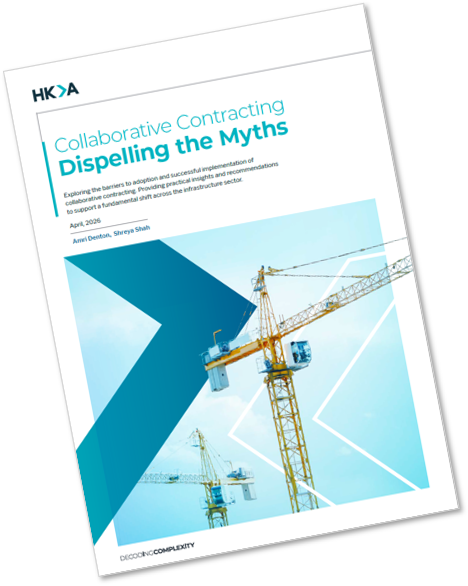
Australia’s infrastructure sector is struggling to translate the promise of collaborative contracting into consistent project outcomes, according to a new HKA report, Collaborative Contracting – Dispelling the Myths, which challenges long-held assumptions and calls for a fundamental reset in how collaboration is implemented.
At a time of escalating costs, supply chain pressure and increasing project complexity, the report argues that improving how collaboration is implemented – not whether it is used – is critical to lifting performance across the sector.
Drawing on extensive delivery experience and insights from HKA authors and infrastructure experts, Amri Denton and Shreya Shah, along with a broad cross‑section of industry stakeholders, the report finds that while collaboration is widely discussed, effective implementation continues to lag due to misconceptions, capability gaps and entrenched behaviours.
While collaborative contracting is now central to industry reform agendas, the report finds its potential is often undermined by outdated assumptions, including the belief that collaboration is synonymous with alliancing, requires excessive effort to establish, or dilutes commercial accountability.
Based on extensive industry consultation and HKA’s real project experience across procurement, delivery and dispute resolution, the report provides a rare end-to-end perspective on why collaborative models succeed or fail in practice.
“The industry talks a lot about collaboration, but many organisations are still not set up to deliver it. Too often, we refine and change contracts without changing the capabilities, governance and behaviours needed to make it work.”
Amri Denton, Partner
The report highlights the most common myths – including the belief that collaboration equals alliancing or that it requires disproportionate effort – and identifies key implementation barriers such as owner readiness, inconsistent governance and a lack of supply chain integration.
It also highlights that while collaborative contracting is not a panacea, it can materially improve outcomes where governance, capability, incentives and culture are aligned.
In his foreword, Sydney Airport’s Group Executive – Planning & Delivery, Paul Willis, emphasises the need for more aligned, transparent delivery approaches to manage growing complexity.
“Major aviation projects operate in complex, live environments. These challenges cannot be addressed through traditional contracting alone. This paper provides a practical roadmap to help owners and the supply chain implement collaborative models with greater clarity, consistency and realism.”
Paul Willis, Sydney Airport
Key insights from the report include:
- Collaborative contracting is a spectrum, not a single model.
- Owners overestimate the effort required to establish collaborative models and underestimate the effort involved in running adversarial ones.
- The biggest constraint is owner capability – not market maturity.
- Real value is unlocked beyond Tier 1 across the full supply chain.
- A collaborative contract alone is not enough – capability and culture are critical.
Recommendations for industry
The report outlines targeted actions for owners, contractors and policymakers, including:
- Shifting the debate from ideology to capability.
- Selecting delivery models based on the problem, not precedent.
- Aligning risk, reward and incentives.
- Investing in organisational capability and empowered governance.
- Providing consistent signals to the market.
- Integrating the supply chain through structured engagement.
A call to action
The authors emphasise that collaborative contracting represents a different operating system – not simply a contractual alternative.
Amri Denton continued, “The question for owners is not whether collaboration has merit, but whether they are truly equipped to implement it. For many, the priority now must be building the readiness, capability and confidence to make it work in practice.”
About the report
Collaborative Contracting – Dispelling the Myths is based on HKA’s global delivery experience across major infrastructure programs, supplemented by insights from leading owners, contractors, consultants, legal practitioners and academics. It explores capability, behavioural and commercial barriers to improved project performance.
| Name | Peita Calvert |
| Title | Marketing and Communications Director, International |
| Number | +61 2 9255 9100 |
| peitacalvert@hka.com |